

Writing
At Leopold Primary School, we believe that writing is a vital tool for communication, creativity and self-expression. Our writing curriculum supports children from Early Years to Year 6 to develop the knowledge, skills and confidence they need to become successful writers.
Our intent is to ensure that children:
- Develop a love of writing and see themselves as authors.
- Become independent, reflective and resilient writers.
- Build strong foundational skills in handwriting, spelling and sentence construction.
- Learn to write clearly for a range of purposes and audiences.
- Understand how vocabulary, grammar and structure work together to create effective writing.
We want every child to leave Leopold as a writer who can communicate confidently, precisely and creatively.
Our Whole-School Writing Approach
Writing is taught consistently across Early Years, Key Stage 1 and Key Stage 2 following a clear writing process. This helps children understand how writing is created, refined and polished, and builds progression as they move through the school.
Across all year groups, writing lessons include reading high-quality texts, learning explicit skills, practising them in small steps and producing purposeful final pieces.
Writing in EYFS
In the early stages, writing focuses on building strong foundations.
Early Years Foundation Stage (EYFS)
- Children learn to write through a balance of play-based and structured activities.
This includes: - Developing fine motor skills for pencil control
- Learning correct letter formation
- Using phonics to segment and spell simple words
- Writing labels, captions and simple sentences
- Discussing stories and building vocabulary
- Beginning to edit their writing with adult support
Writing in EYFS is closely linked to early reading and communication development. Children are encouraged to see themselves as writers from the very start.
Writing in Key Stage 1 (Years 1 & 2)
In KS1, children build confidence and fluency.
They learn to:
- Write sentences using capital letters, finger spaces and full stops
- Join ideas using simple conjunctions
- Use phonics to spell and apply common spelling patterns
- Start to organise ideas into short pieces of writing
- Begin to understand purpose (e.g. story, letter, recount)
- Use adjectives and adverbs to add detail
- Edit for simple corrections with support
Children in KS1 continue to follow an adapted version of the writing process, with strong scaffolding and modelling from the teacher.
Writing in Key Stage 2 (Years 3–6)
In KS2, pupils develop greater independence, control and sophistication in their writing.
They learn to:
- Write for a wide range of purposes and audiences
- Organise writing into paragraphs
- Use varied sentence structures for effect
- Apply ambitious vocabulary and precise grammar
- Develop narrative techniques such as dialogue, setting and character
- Write clear explanations, reports, letters, arguments and more
- Edit and improve writing with increasing independence
- Adapt tone and style depending on the task
By Upper KS2, children are confident in planning, drafting and revising extended pieces of writing.
Lesson Structure Across the School
A typical writing sequence includes:
- Immersion and Idea Building
Children explore high-quality texts, images or experiences to inspire writing.
This includes talking about ideas, exploring vocabulary and identifying text features.
- Modelling and Shared Writing
Teachers demonstrate how to plan and write effectively.
Children help to compose sentences and see how writing is structured.
- Guided Practice
Short, focused tasks help pupils practise key skills such as grammar, vocabulary choices and sentence construction.
- Independent Writing
Children apply learning to produce a piece of writing for a purpose and audience appropriate to their age.
- Editing and Improving
Pupils develop the ability to edit and improve – from simple corrections in KS1 to thoughtful revisions and additions in KS2.
- Publishing and Celebrating Writing
Final pieces may be displayed, read aloud, typed, or included in class books. We celebrate progress at every stage.
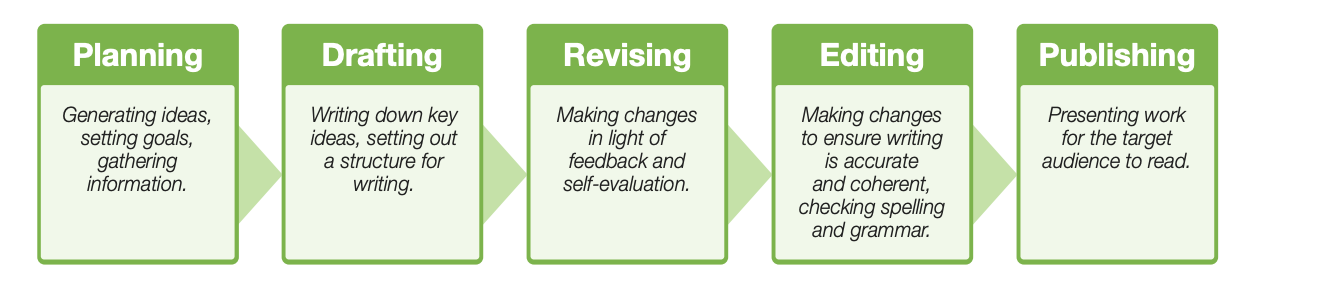
The Writing Process
Across all year groups, children are taught a consistent writing process:
Planning – generating and organising ideas
Drafting – writing a first version
Revising – improving ideas, vocabulary and structure
Editing – checking spelling, punctuation and grammar
Publishing – presenting final writing with pride
This supports pupils’ independence and confidence as writers.
Handwriting
We follow the Nelson Handwriting scheme from Year 1 to Year 6, providing a consistent and progressive approach to handwriting across the school.
In the Early Years Foundation Stage (EYFS), children develop the foundations for successful handwriting through fine and gross motor activities and are taught correct letter formation using a structured and systematic approach.
In Key Stage 1 (KS1), pupils continue to develop accurate letter formation and increasing fluency, with a focus on consistent letter size, orientation and spacing. The Nelson Handwriting scheme supports pupils in developing a clear, legible and increasingly confident handwriting style.
In Key Stage 2 (KS2), pupils build on these foundations and develop a fluent, joined handwriting style. Through the Nelson Handwriting scheme, children are supported to increase their writing speed, stamina and legibility, enabling them to write confidently and effectively across the curriculum.
Spelling
From EYFS through to Key Stage 1, phonics provides the foundation for early spelling, enabling children to segment and encode words with growing confidence.
From Year 1 to Year 6, we use Spelling Shed to support the teaching and practice of spelling. This ensures a consistent, engaging and progressive approach across the school.
In Key Stage 2, pupils build on their phonics knowledge by exploring spelling patterns, prefixes, suffixes and word morphology, helping them to understand the structure and meaning of words more deeply.
Grammar and Punctuation
Grammar and punctuation are taught both explicitly and within the context of writing lessons.
In KS1, children begin by constructing simple sentences with appropriate punctuation.
In KS2, pupils develop their understanding further, using a range of sentence structures and punctuation choices to create varied, precise and sophisticated writing.
Impact
By the end of Year 6, children at Leopold Primary School:
- Write confidently and fluently
- Use grammar, punctuation and vocabulary purposefully
- Organise ideas effectively for a range of purposes
- Edit and improve their work with independence
- Take pride in presenting writing to a high standard
- Enjoy writing and recognise its value in everyday life
Progress is monitored through teacher assessment, written pieces, discussions and regular opportunities for editing and reflection. All children are supported to achieve their potential.
Supporting Writing at Home
Parents can help by:
- Encouraging children to talk about ideas before writing
- Providing opportunities to write (stories, lists, diaries, letters)
- Practising spellings regularly on Spelling Shed at home to help reinforce learning and build confidence.
- Reading regularly to build vocabulary and inspire ideas
- Praising creativity, imagination and effort